- English
- French
- German
- Portuguese
- Spanish
- Russian
- Japanese
- Korean
- Arabic
- Greek
- German
- Turkish
- Italian
- Danish
- Romanian
- Indonesian
- Czech
- Afrikaans
- Swedish
- Polish
- Basque
- Catalan
- Esperanto
- Hindi
- Lao
- Albanian
- Amharic
- Armenian
- Azerbaijani
- Belarusian
- Bengali
- Bosnian
- Bulgarian
- Cebuano
- Chichewa
- Corsican
- Croatian
- Dutch
- Estonian
- Filipino
- Finnish
- Frisian
- Galician
- Georgian
- Gujarati
- Haitian
- Hausa
- Hawaiian
- Hebrew
- Hmong
- Hungarian
- Icelandic
- Igbo
- Javanese
- Kannada
- Kazakh
- Khmer
- Kurdish
- Kyrgyz
- Latin
- Latvian
- Lithuanian
- Luxembou..
- Macedonian
- Malagasy
- Malay
- Malayalam
- Maltese
- Maori
- Marathi
- Mongolian
- Burmese
- Nepali
- Norwegian
- Pashto
- Persian
- Punjabi
- Serbian
- Sesotho
- Sinhala
- Slovak
- Slovenian
- Somali
- Samoan
- Scots Gaelic
- Shona
- Sindhi
- Sundanese
- Swahili
- Tajik
- Tamil
- Telugu
- Thai
- Ukrainian
- Urdu
- Uzbek
- Vietnamese
- Welsh
- Xhosa
- Yiddish
- Yoruba
- Zulu
How to Choose Titanium Tube Sheet for Industrial Applications
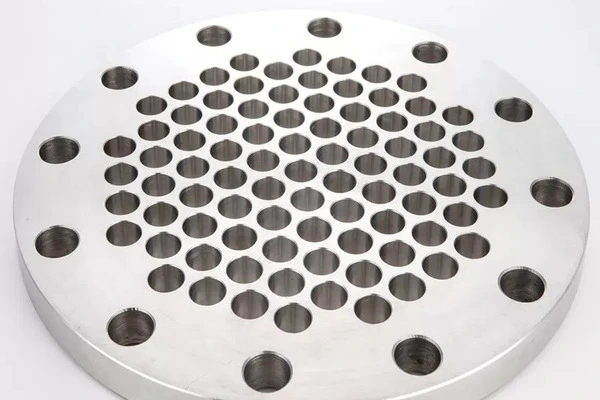
It is important to choose the right titanium tube sheet for industrial uses so that chemical equipment works well and lasts a long time. The corrosion resistance and long service life of Titanium Tube Plate for Chemical Equipment make it ideal for use in harsh conditions. This guide tells you what to think about when picking out the right titanium tube sheet for your project.
Selecting the Correct Titanium Grade
It is very important to choose the right titanium type when picking a Titanium Tube Plate for Chemical Equipment. There are different grades that offer different levels of strength, resistance to corrosion, ability to be shaped, and temperature range. Metals like Grade 2 titanium are used for chemical equipment that needs to be able to bend and resist corrosion well. Ti-6Al-4V (Grade 5) has a lot more mechanical strength, but that doesn't mean it's always the best choice for work with corrosive chemicals.
Factors Influencing Grade Selection
Consider the following factors when choosing a Titanium Tube Plate for Chemical Equipment:
• Chemical composition and concentration of process fluids
• Normal and maximum operating temperature range
• Design and operating pressure
• Mechanical, thermal, and cyclic stresses
Consulting metallurgists or experienced Titanium Tube Sheet OEM manufacturers can help confirm that the selected grade matches the requirements of your application.

Common Titanium Grades for Chemical Equipment
The following titanium grades are commonly considered for Titanium Tube Plate for Chemical Equipment:
• Grade 1 offers excellent formability and corrosion resistance; for relatively low strength requirements
• Grade 2 provides a useful balance of strength, formability, and corrosion resistance and is used in chemical processing
• Grade 7 contains palladium and provides enhanced corrosion resistance in reducing or acidic chemical environments
• Grade 12 provides higher strength than commercially pure titanium with corrosion resistance for selected applications
Required Thickness and Mechanical Strength
Finding the right thickness and mechanical strength for your Titanium Tube Plate for Chemical Equipment is important for making sure it stays together and works well. The plate's ability to handle different pressures, tube loads, temperature effects, and other working conditions without deforming too much depends on how thick it is.
Calculating Required Thickness
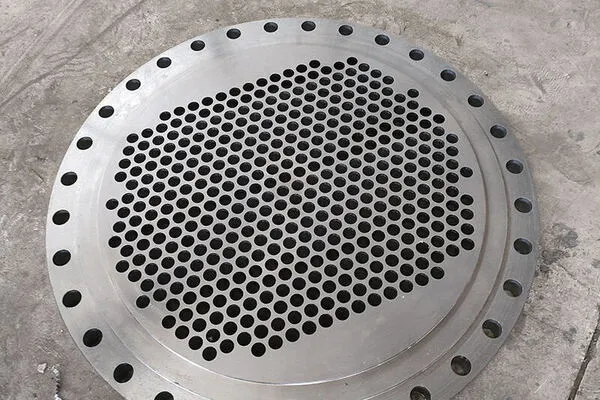
Consider design pressure, operating temperature, unsupported span, tube-hole arrangement, material allowable stress, and applicable safety factors when determining the required thickness for your Titanium Tube Plate for Chemical Equipment.
Based on these factors, engineers apply design codes or engineering calculations to determine the minimum required thickness. It is important to work with experienced Titanium Tube Sheet OEM providers who can evaluate these parameters and provide an appropriate design for the intended service.

Mechanical Strength Considerations
Titanium Tube Plate for Chemical Equipment must be strong enough to handle:
• Static loads such as equipment weight and fluid pressure
• Dynamic loads caused by fluid flow, thermal expansion, or operation
• Potential vibration, fatigue, or cyclic loading
Make sure the selected titanium grade and thickness provide suitable allowable stress, yield strength, tensile strength, and fatigue performance for the application. Material properties should be evaluated at the design temperature rather than assumed from room-temperature data.
Corrosion, Crevice and Crevice Corrosion Checks
Corrosion resistance is a primary reason for choosing Titanium Tube Plate for Chemical Equipment. However, material selection should be based on the chemical environment, temperature, concentration, and operating conditions rather than assumptions about titanium.
General Corrosion Assessment
When evaluating Titanium Tube Plate for Chemical Equipment, consider the following:
• pH and concentration of process fluids
• Presence of chlorides, fluorides, or other aggressive ions
• Oxidizing or reducing conditions
• Temperature and flow effects on corrosion rates
Review reliable corrosion data or conduct laboratory testing when needed to determine whether the selected titanium grade will perform adequately in the chemical environment.
Crevice Corrosion Prevention
Crevice corrosion can occur under chemical and temperature conditions, particularly where deposits or restricted fluid circulation affect the passive surface. To reduce this risk in your Titanium Tube Plate for Chemical Equipment:
• Use designs that minimize stagnant crevices and deposits
• Select grades appropriate for the chemical environment
• Use suitable joining and assembly methods to limit crevice formation
• Inspect and maintain the equipment to identify corrosion early
These decisions can be improved by working with Titanium Tube Sheet OEM manufacturers experienced in chemical equipment.
Conclusion
When picking the right Titanium Tube Plate for Chemical Equipment, you need to think about a number of things. These factors include the titanium grade, the required thickness, the mechanical load, and corrosion resistance. When you look at the operating conditions and talk to engineers, you can choose a tube sheet that supports the performance and service life of the equipment. Titanium's corrosion resistance and longevity can lower upkeep costs and support long-term operating value, despite the fact that it may have higher original material costs.
FAQ
What is the average length of time that a Titanium Tube Plate for Chemical Equipment lasts?
A: Titanium tube plates can provide long service in many chemical processing applications, but their service life depends on grade, temperature, pressure, chemical composition, fabrication quality, and maintenance. A fixed service-life figure should not be assumed without application-specific data.
Can titanium tube sheets be joined together?
A: Titanium tube sheets can be joined using suitable welding or other qualified joining processes. Welding requires appropriate procedures, clean surfaces, shielding gas, and controlled conditions to prevent contamination and protect joint quality.
Are there any chemicals that titanium shouldn't be used with?
A: Titanium is resistant to many chemical environments, but conditions involving fluoride-containing solutions, dry chlorine, strong reducing acids, or high-temperature media may cause corrosion or other material limitations. Compatibility should be checked for the concentration and temperature.
Expert Titanium Tube Plate Manufacturing Solutions
Baoji Huacan New Metal Materials Co., Ltd. provides Titanium Tube Plate for Chemical Equipment for demanding applications. Our production team focuses on material selection, precision machining, dimensional control, and inspection to support consistent product quality. Based on your drawings, we can discuss suitable titanium grades, dimensions, tube-hole layouts, and manufacturing requirements. Please email us at Joy@hc-titanium.com or Sherry@hc-titanium.com with your drawings, material requirements, operating conditions, and details for evaluation and quotation.
References
1. Smith, J.R. (2020). "Advanced Materials for Chemical Processing Equipment". Chemical Engineering Journal, 65(3), 215-230.
2. Chen, L. et al. (2019). "Corrosion Behavior of Titanium Alloys in Industrial Chemical Environments". Materials and Corrosion, 70(8), 1456-1470.
3. Johnson, A.B. (2021). "Design Considerations for Titanium Heat Exchangers". Industrial & Engineering Chemistry Research, 60(15), 5678-5690.
4. Williams, D.F. and Brown, S.A. (2018). "Titanium in Industrial Applications: Properties and Performance". Materials Science and Technology, 34(10), 1193-1206.
5. Zhao, X. and Zhang, Y. (2022). "Recent Advances in Titanium Alloy Development for Chemical Processing Industries". Journal of Materials Engineering and Performance, 31(4), 2345-2360.
_1755480185726.jpg)


Learn about our latest products and discounts through SMS or email