- English
- French
- German
- Portuguese
- Spanish
- Russian
- Japanese
- Korean
- Arabic
- Greek
- German
- Turkish
- Italian
- Danish
- Romanian
- Indonesian
- Czech
- Afrikaans
- Swedish
- Polish
- Basque
- Catalan
- Esperanto
- Hindi
- Lao
- Albanian
- Amharic
- Armenian
- Azerbaijani
- Belarusian
- Bengali
- Bosnian
- Bulgarian
- Cebuano
- Chichewa
- Corsican
- Croatian
- Dutch
- Estonian
- Filipino
- Finnish
- Frisian
- Galician
- Georgian
- Gujarati
- Haitian
- Hausa
- Hawaiian
- Hebrew
- Hmong
- Hungarian
- Icelandic
- Igbo
- Javanese
- Kannada
- Kazakh
- Khmer
- Kurdish
- Kyrgyz
- Latin
- Latvian
- Lithuanian
- Luxembou..
- Macedonian
- Malagasy
- Malay
- Malayalam
- Maltese
- Maori
- Marathi
- Mongolian
- Burmese
- Nepali
- Norwegian
- Pashto
- Persian
- Punjabi
- Serbian
- Sesotho
- Sinhala
- Slovak
- Slovenian
- Somali
- Samoan
- Scots Gaelic
- Shona
- Sindhi
- Sundanese
- Swahili
- Tajik
- Tamil
- Telugu
- Thai
- Ukrainian
- Urdu
- Uzbek
- Vietnamese
- Welsh
- Xhosa
- Yiddish
- Yoruba
- Zulu
Emerging Applications of Titanium Bar in Robotics
When low density, strength, corrosion resistance, and dimensional stability are important, the robotics industry uses titanium bars more and more. Titanium materials can support structures that are very light while still having the mechanical strength needed for complex robotic systems. Mobile robots, marine platforms, and some medical robotic parts are all examples of uses.
Lightweight Structural Components for Mobile Robots
In mobile robotics, the weight of the structure affects the payload, the speed, the amount of energy used, and the operating time. Titanium bar offers a high specific strength, which lets engineers look at making structure parts that are lighter without just adding more material. The final benefit depends on the type of alloy, the shape of the part, the load, the need for stiffness, and the manufacturing tolerances.
Enhancing Mobility and Agility
If the design is done right, using titanium bars in certain structure sections can lower the weight of the parts while still meeting the functional requirements. Less structure mass may make it easier to move, accelerate, and use actuators more efficiently. These perks are especially useful for mobile platforms that need to act quickly or work on rough ground.
In search and rescue robots, for example, lightweight structural components can help manage battery capacity and payload allocation. A titanium bar component may also provide sufficient strength for mounting sensors, tools, or other equipment. However, actual mobility gains should be evaluated from the complete robot design rather than attributed to the material alone.

Improving Energy Efficiency
Battery-powered robots must balance structural mass with available energy. Reducing unnecessary frame weight can lower the energy required for acceleration and movement, potentially increasing operating time under comparable operating conditions. Titanium materials can therefore be considered when weight reduction has a clear engineering benefit.
This consideration also applies to selected autonomous drones and other lightweight platforms. However, flight time depends on the airframe, propulsion system, battery, payload, aerodynamics, and operating profile. Titanium bar should therefore be selected based on the complete weight and performance budget rather than assuming a fixed increase in flight time.
Enhancing Payload Capacity
Engineers can use a lightweight building material to help payloads take up more of a robot's allowed mass while still keeping the structure strong and rigid. Titanium bar could be useful for frames, supports, shafts, and other parts that need to meet more than one of these needs.
Titanium parts could be used for robot structures in warehouse automation that need to be a good mix of weight, strength, and longevity. The payload capacity is still based on the motors, actuators, gear systems, structure geometry, center of gravity, and the way the controls are set up. So, choosing the right materials should not replace system-level planning, but rather work with it.
Corrosion-Resistant Arms for Marine Robots
Underwater robots work in places where seawater, pressure, cyclic loading, and touching metals that are not the same can affect how well parts work. Titanium materials are very resistant to corrosion by seawater, so they can be used for robotic arms, supports, housings, and other parts that will be used in the ocean.
Ensuring Longevity in Saltwater Environments
In many seawater environments, titanium forms a stable, adherent passive oxide film that offers excellent corrosion resistance. Although this trait can help slow down corrosion, performance is still affected by the type of material, temperature, water chemistry, surface state, flow, and galvanic coupling with dissimilar metals.
Because of this, titanium bar can be used for long periods of time in marine robotic arms and structural parts where corrosion resistance is important. How long something actually lasts relies on how it was made, how well it's maintained, how much it's used, and its surroundings. When titanium is connected to metals that are not the same, galvanic isolation may also be needed.

Maintaining Structural Integrity Under Pressure
Robots that work in the deep sea are subject to hydrostatic pressure that increases with depth. Titanium materials can give structural parts useful strength and corrosion resistance, but pressure resistance depends on the whole design. It is important to think about the shell shape, wall thickness, buckling resistance, joints, seals, material condition, and safety factors.
Remotely operated vehicles used for offshore inspection may use titanium components in selected areas where strength, corrosion resistance, and weight are important. The suitability of a titanium bar component should be confirmed through structural analysis and, where required, qualification or pressure testing appropriate to the system design.
Enhancing Precision in Underwater Operations
Titanium bar can contribute to lightweight robotic arms and other moving structures where low mass and adequate stiffness are required. Reducing moving mass can help actuator control, but positioning accuracy also depends on joint design, bearings, actuators, sensors, control algorithms, and structural stiffness.
In underwater inspection, sampling, or research systems, titanium components may support stable movement in corrosive environments. The required dimensional tolerances, surface finish, and machining quality should be defined according to the robotic mechanism and its operating conditions.
Biocompatible End-Effectors for Surgical Bots
Medical robotics places strict requirements on materials used in components that may contact instruments, fluids, or the patient-contact environment. Selected titanium materials are widely used in medical applications because of their corrosion resistance, mechanical performance, and favorable biocompatibility when appropriately processed and qualified.
Ensuring Biocompatibility in Surgical Applications
Titanium and selected titanium alloys can offer favorable biocompatibility, but suitability for a medical robotic component depends on alloy grade, surface condition, manufacturing process, cleaning, sterilization, and intended use. A material should not be described as universally biocompatible without considering the applicable medical requirements.
For surgical robotic components, titanium bar may be considered where strength, low density, corrosion resistance, and compatibility with cleaning or sterilization processes are required. Infection risk is controlled by the complete device design, manufacturing controls, cleaning, sterilization, and clinical procedures rather than by titanium alone.

Enhancing Precision and Control
Low density combined with suitable strength and stiffness can make titanium bar useful for selected robotic links and end-effectors. Lower component mass can reduce inertial loads and may support responsive actuator control. Dimensional accuracy, joint clearances, bearing performance, and control-system design remain essential to final positioning accuracy.
For microsurgical equipment, the material is only one part of the precision system. CNC machining, dimensional inspection, surface finish, and component assembly must meet the specified requirements. Titanium materials should therefore be selected together with the complete mechanical and manufacturing design.
Improving Durability and Sterilization
Titanium materials can provide good durability and corrosion resistance in selected medical applications. Their suitability for repeated sterilization depends on the alloy, surface treatment, sterilization method, component design, and applicable qualification requirements. It should not be assumed that every titanium bar product is suitable for every sterilization process.
For reusable robotic components, dimensional stability and surface condition are important after repeated cleaning and sterilization. Manufacturing controls and inspection can help verify that critical dimensions and functional surfaces remain within specified limits.
Conclusion
Titanium bar can support robotics applications that require a combination of low density, mechanical strength, corrosion resistance, and suitable dimensional stability. Its value depends on the alloy grade, material condition, component geometry, surface condition, manufacturing process, and service environment. Engineers should evaluate these factors against the actual load, stiffness, pressure, fatigue, sterilization, and corrosion requirements of each robotic system.

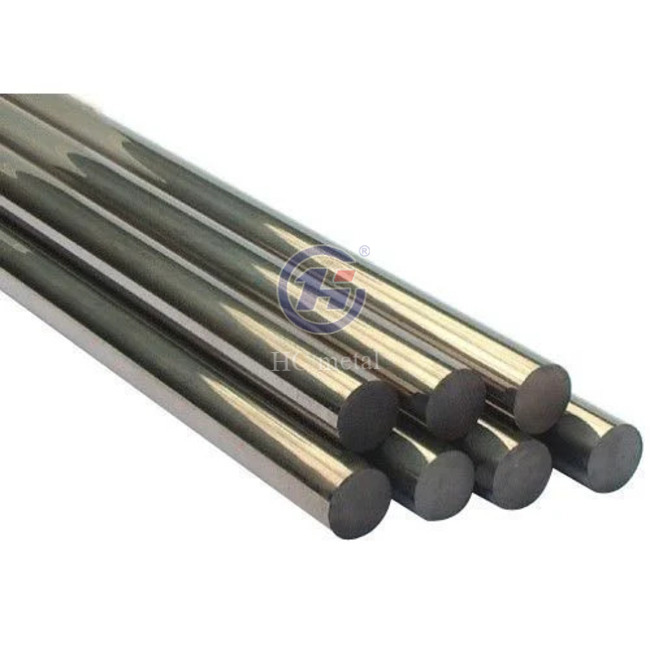
Baoji Huacan New Metal Materials Co., Ltd. supplies titanium products for industrial applications and supports material selection, precision rolling, CNC machining, and inspection according to specified requirements. Our titanium materials can be supplied according to applicable grades, dimensions, material conditions, specifications, and customer drawings. For robotics projects, buyers can provide the required grade, bar diameter, length, quantity, tolerances, surface requirements, and inspection specifications for technical evaluation. For procurement teams, the key selection criteria should include material certification, dimensional tolerances, mechanical properties, surface condition, traceability, and delivery requirements.
Frequently Asked Questions
What makes titanium bars suitable for robotics applications?
Titanium bar can provide a useful combination of low density, high specific strength, corrosion resistance, and durability. Suitability depends on the application, alloy grade, component design, and required mechanical and environmental performance.
How do titanium bars improve the performance of mobile robots?
Titanium bar can reduce structural mass while maintaining required strength when properly designed. Lower mass may improve acceleration, maneuverability, and energy use, but overall performance also depends on actuators, batteries, control systems, payload, and robot geometry.
Why are titanium bars preferred for marine robotics?
Titanium materials provide strong resistance to seawater corrosion and can offer useful mechanical performance in demanding marine environments. Their suitability for deep-sea systems still depends on pressure-vessel design, fatigue loading, galvanic compatibility, material condition, and applicable testing.
What advantages do titanium bars offer in surgical robotics?
Selected titanium alloys can provide low density, strength, corrosion resistance, and favorable biocompatibility when appropriately processed and qualified. Medical suitability also depends on the intended use, surface condition, cleaning, sterilization, and applicable regulatory requirements.
How does Baoji Huacan ensure the quality of its titanium bars for robotics?
Baoji Huacan supports production through controlled manufacturing, CNC machining, dimensional inspection, and specified quality requirements. Customers can request documentation and inspection requirements according to the applicable material specification and project needs.
Revolutionizing Robotics with Premium Titanium Bars
Robotic manufacturers need material suppliers that can provide more than generic titanium bar stock. Baoji Huacan New Metal Materials Co., Ltd. supports projects requiring specified grades, dimensions, machining, and inspection requirements. Our manufacturing capabilities include precision rolling and CNC machining, while quality control is aligned with the applicable product specification and customer requirements.
Whether you are developing mobile robots, marine inspection equipment, or selected medical robotic components, titanium materials should be evaluated against the actual engineering requirements rather than general material claims. Contact our team at Joy@hc-titanium.com or Sherry@hc-titanium.com with your titanium bar grade, dimensions, quantity, applicable specification, drawing, and inspection requirements. We can review the requirements and discuss a suitable manufacturing solution for your robotics project.
References
1. Johnson, M. R., & Smith, K. L. (2022). Advancements in Titanium Alloys for Next-Generation Robotics. Journal of Robotic Materials, 15(3), 245-260.
2. Zhang, Y., & Brown, T. (2021). Corrosion Resistance of Titanium in Marine Robotic Applications. Underwater Technology, 39(2), 112-128.
3. Davis, E. H., & Wilson, R. J. (2023). Biocompatible Materials in Surgical Robotics: A Comprehensive Review. Medical Robotics and Computer Assisted Surgery, 19(4), 301-318.
4. Liu, X., & Patel, S. (2022). Lightweight Structural Materials for Mobile Robotics: Current Trends and Future Prospects. Advanced Robotics, 36(5), 178-195.
5. Thompson, A. L., & Garcia, M. (2023). The Role of Titanium Alloys in Enhancing Robotic Performance: A Comparative Analysis. Robotics and Autonomous Systems, 158, 104-120.
_1755153145516.jpg)


Learn about our latest products and discounts through SMS or email