- English
- French
- German
- Portuguese
- Spanish
- Russian
- Japanese
- Korean
- Arabic
- Greek
- German
- Turkish
- Italian
- Danish
- Romanian
- Indonesian
- Czech
- Afrikaans
- Swedish
- Polish
- Basque
- Catalan
- Esperanto
- Hindi
- Lao
- Albanian
- Amharic
- Armenian
- Azerbaijani
- Belarusian
- Bengali
- Bosnian
- Bulgarian
- Cebuano
- Chichewa
- Corsican
- Croatian
- Dutch
- Estonian
- Filipino
- Finnish
- Frisian
- Galician
- Georgian
- Gujarati
- Haitian
- Hausa
- Hawaiian
- Hebrew
- Hmong
- Hungarian
- Icelandic
- Igbo
- Javanese
- Kannada
- Kazakh
- Khmer
- Kurdish
- Kyrgyz
- Latin
- Latvian
- Lithuanian
- Luxembou..
- Macedonian
- Malagasy
- Malay
- Malayalam
- Maltese
- Maori
- Marathi
- Mongolian
- Burmese
- Nepali
- Norwegian
- Pashto
- Persian
- Punjabi
- Serbian
- Sesotho
- Sinhala
- Slovak
- Slovenian
- Somali
- Samoan
- Scots Gaelic
- Shona
- Sindhi
- Sundanese
- Swahili
- Tajik
- Tamil
- Telugu
- Thai
- Ukrainian
- Urdu
- Uzbek
- Vietnamese
- Welsh
- Xhosa
- Yiddish
- Yoruba
- Zulu
Titanium Rod OEM Manufacturing: Custom Sizes and Grades Available
Titanium rod production has changed a lot over the years, giving companies more sizes, grades, and specifications to choose from. Customised Titanium rod goods are being used more and more in areas like medical equipment and aircraft. This article talks about making OEM titanium rods and how different businesses can find rods with certain grades, sizes, standards, and surface conditions.
Standard Grades: Pure Titanium Grade 1–4 Options
To choose the right titanium material for a job, you need to know about the different types of titanium. Grades 1 through 4 are widely used commercially pure titanium grades that are used in many fields because they have different levels of corrosion resistance, strength, ductility, and formability.
Grade 1 Titanium Rod: Unalloyed Purity
Grade 1 titanium is the purest commercially pure titanium grade that can be sold, but it is also the weakest. It is very resistant to corrosion, easy to bend, and easy to shape, so it can be used in situations that need a lot of shaping or deep drawing. This kind of Titanium rod is often used in heat exchangers, chemical processing equipment, and other parts that need to be resistant to corrosion and easy to shape.
Grade 2 Titanium Rod: Versatile Performance
Grade 2 is one of the most widely used commercially pure titanium grades for Titanium rod production. It provides a practical balance of strength, ductility, corrosion resistance, and formability, making it suitable for a broad range of industrial applications. Because of its corrosion resistance and moderate mechanical strength, Grade 2 Titanium rod is commonly used in chemical processing equipment, marine environments, and electrolysis-related equipment.
Grade 3 Titanium Rod: Enhanced Strength
Grade 3 Titanium rod provides higher strength than Grade 2 while retaining useful ductility and formability. It can be selected when an application requires additional mechanical strength without moving to an alloyed titanium grade. Typical applications may include pressure-related components, chemical processing equipment, and selected aerospace components where strength-to-weight performance and corrosion resistance are important.
Grade 4 Titanium Rod: Maximum Strength in CP Titanium
Grade 4 is the highest-strength grade among commercially pure titanium grades. It provides higher tensile and yield strength than Grades 1–3 while retaining good corrosion resistance. This type of Titanium rod may be selected for applications requiring higher mechanical strength without using an alloyed grade, including certain aerospace, marine, chemical processing, and medical component applications.
Custom Diameter and Length Tolerance Ranges
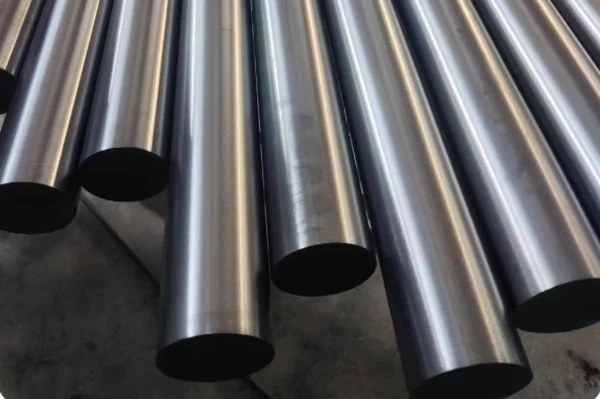
For OEM Titanium rod orders, the ability to produce different diameters, lengths, and tolerances is important for meeting application-specific requirements. Dimensional tolerances determine how accurately the finished rod conforms to the customer's drawing or applicable product specification and whether it can be integrated into the intended assembly.
Diameter Tolerance for Titanium Rod
Titanium rod manufacturers may provide different diameter tolerances depending on the rod size, production process, material condition, and applicable specification. For selected small-diameter products, tighter tolerances such as ±0.05 mm may be achievable when supported by the manufacturing process and inspection requirements. For larger diameters, allowable tolerances may be wider and should be defined according to the applicable standard or customer drawing rather than treated as a universal value.
Length Tolerance for Titanium Rod
Length tolerances depend on the required dimensions, production method, and cut-to-length process. For shorter rods, a tighter length tolerance may be available when specified in the drawing or purchase requirements. For longer Titanium rod products, the tolerance may need to account for cutting, straightening, finishing, and measurement conditions. The final allowable length deviation should therefore be agreed according to the required specification.
Straightness and Roundness in Titanium Rod Manufacturing
OEM Titanium rod manufacturers need to control more than diameter and length. Straightness and roundness are also important dimensional characteristics, particularly when rods are used in precision assemblies or further machining operations. Straightness may be specified as a maximum deviation over a defined length, while roundness controls the deviation of the rod's cross-section from a true circular profile. The applicable limits should be based on the relevant product standard or customer drawing.
Certification: Mill Test Reports & Material Traceability
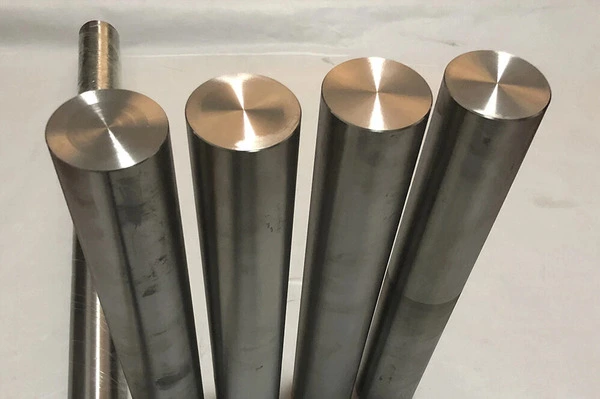
Certification and material traceability are important for Titanium rod procurement, particularly for aerospace, medical, chemical processing, and other applications with controlled material requirements. Proper documentation allows buyers to verify the supplied titanium material and trace it back to its production batch when required.
Mill Test Reports for Titanium Rod
Mill Test Reports (MTRs) provide documented information about the supplied titanium material. Depending on the applicable specification, an MTR may include chemical composition, mechanical properties, heat number, heat-treatment condition, and compliance with the specified material standard. Important information may include:
- Chemical composition results showing elements such as carbon, iron, oxygen, nitrogen, and hydrogen where specified.
- Mechanical test results, including tensile strength, yield strength, and elongation.
- Heat-treatment or material condition information where applicable.
- Compliance with the specified manufacturing standard, such as ASTM B348.
Material Traceability in Titanium Rod Production
Material traceability means maintaining records that connect the original titanium material with the finished Titanium rod. Depending on the manufacturer's quality system, this process may include:
- Heat numbers assigned to individual batches of titanium material.
- Lot numbers used to identify specific production runs.
- Records of processing operations, including heat treatment and surface finishing where applicable.
- Retention of production or inspection records according to the company's quality procedures.
Quality Assurance in Titanium Rod Manufacturing
Quality assurance for Titanium rod production involves more than document control. Depending on the product specification and customer requirements, manufacturers may perform several inspections and tests during production:
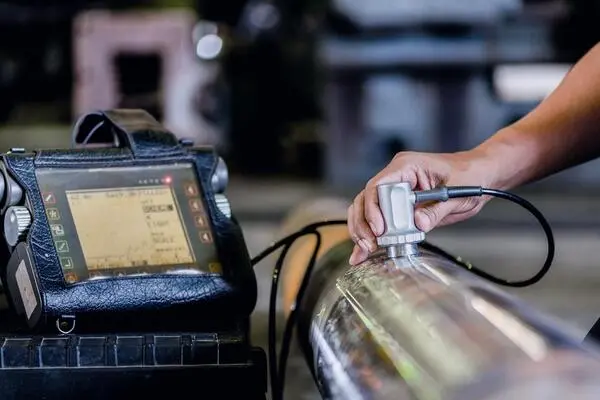
- Non-destructive testing (NDT), such as ultrasonic testing, when specified to detect internal discontinuities.
- Surface inspection to verify that the rod meets the specified surface condition.
- Dimensional inspection to confirm diameter, length, straightness, and other specified requirements.
- Final inspection and documentation review before the Titanium rod is released for shipment
Conclusion
Titanium rod OEM manufacturing gives businesses greater flexibility when they require specific grades, dimensions, tolerances, and surface conditions. Commercially pure titanium Grades 1–4 provide different combinations of strength, ductility, formability, and corrosion resistance, while custom production allows dimensions to be matched to application requirements. Appropriate certification and material traceability are also essential for confirming that the supplied titanium material meets the specified requirements and can be traced to its production batch. As industrial applications continue to demand lightweight, corrosion-resistant materials, custom Titanium rod manufacturing remains an important option for engineered components.
We are proud of our Titanium rod manufacturing capabilities at Baoji Huacan New Metal Materials Co., Ltd. Located in Baoji City, China's "Titanium Valley," we provide titanium material processing and rod manufacturing for customized industrial requirements. Our production capabilities support standard grades as well as customer-defined dimensions, tolerances, and specifications.
Frequently Asked Questions
How long is the longest Titanium rod that can be supplied?
Titanium rods up to 6000 mm long can be produced according to the required grade, diameter, production process, and applicable specification.
Do you supply polished Titanium rods for OEM applications?
Yes. Titanium rods can be supplied with polished or mill-finish surfaces, depending on the required application, production process, and customer specifications.
What standards can your Titanium rods meet?
Our Titanium rods can be supplied according to applicable standards such as ASTM B348 when specified in the order. Material documentation can be provided according to the agreed requirements.
Do you offer Titanium rods with non-standard diameters?
Yes. Custom Titanium rods with diameters from 1 mm to 300 mm can be evaluated according to the required grade, dimensions, tolerances, production process, and quantity.
Titanium Rod Manufacturing: Precision and Quality Assured
Our Titanium rod manufacturing process at Baoji Huacan combines controlled production processes with dimensional and material inspection. Depending on the required specification, titanium material can undergo forming, rolling, finishing, and other processing operations before final inspection. Production controls help maintain dimensional consistency and the required surface condition. Our Titanium rods are supplied for applications ranging from medical components to aerospace and industrial equipment. Contact our team at Joy@hc-titanium.com or Sherry@hc-titanium.com with your required grade, diameter, length, tolerance, quantity, and applicable standard to discuss your technical requirements and request a quotation.


Learn about our latest products and discounts through SMS or email