- English
- French
- German
- Portuguese
- Spanish
- Russian
- Japanese
- Korean
- Arabic
- Greek
- German
- Turkish
- Italian
- Danish
- Romanian
- Indonesian
- Czech
- Afrikaans
- Swedish
- Polish
- Basque
- Catalan
- Esperanto
- Hindi
- Lao
- Albanian
- Amharic
- Armenian
- Azerbaijani
- Belarusian
- Bengali
- Bosnian
- Bulgarian
- Cebuano
- Chichewa
- Corsican
- Croatian
- Dutch
- Estonian
- Filipino
- Finnish
- Frisian
- Galician
- Georgian
- Gujarati
- Haitian
- Hausa
- Hawaiian
- Hebrew
- Hmong
- Hungarian
- Icelandic
- Igbo
- Javanese
- Kannada
- Kazakh
- Khmer
- Kurdish
- Kyrgyz
- Latin
- Latvian
- Lithuanian
- Luxembou..
- Macedonian
- Malagasy
- Malay
- Malayalam
- Maltese
- Maori
- Marathi
- Mongolian
- Burmese
- Nepali
- Norwegian
- Pashto
- Persian
- Punjabi
- Serbian
- Sesotho
- Sinhala
- Slovak
- Slovenian
- Somali
- Samoan
- Scots Gaelic
- Shona
- Sindhi
- Sundanese
- Swahili
- Tajik
- Tamil
- Telugu
- Thai
- Ukrainian
- Urdu
- Uzbek
- Vietnamese
- Welsh
- Xhosa
- Yiddish
- Yoruba
- Zulu
Welded Titanium Footpegs: Built to Handle Any Terrain
When you're going off-road, every part is important. For dirt bike and motorcycle enthusiasts looking for a balance of performance and durability, welded titanium footpegs have become a practical upgrade. They offer high strength with relatively low weight. They offer reliable grip, strength, and durability, making them useful for riders who expect their machines to work reliably.
The Revolution of Titanium in Motorcycle Accessories
The Advantages of Welded Titanium Footpegs
Welded titanium footpegs are a useful improvement in the technology of motorcycle footrests. When titanium metal, especially Ti-6Al-4V, is used, the strength-to-weight ratio is very high. With this choice of material, makers can make footpegs that are light without sacrificing the strength needed for demanding applications. The weight of about 220g per pair should be taken into account for each model. Consistent longevity depends on things like the quality of the welding, the design of the joints, and the checking.
The Science Behind Titanium's Superiority
Titanium is good for motorbike parts that need to be strong, light, and resistant to the elements because of its qualities. Because titanium has a high strength-to-density ratio, welded titanium footpegs can hold rider loads and service forces while adding very little weight to the bike. Titanium also naturally forms a steady oxide layer that helps protect it from corrosion, helping the material retain its properties when exposed to mud, water, road salts, and other weather conditions found when off-road riding.
Enhancing Ride Quality and Control
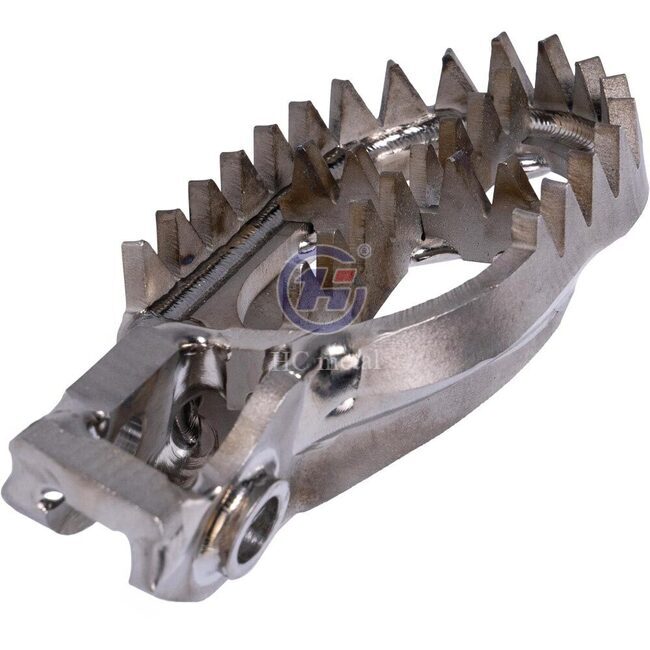
More than just a place to put your feet up, welded titanium footpegs also serve other purposes. Their design, which usually includes a wide support platform, gives your feet a good place to touch and stay put. Riders can stay more balanced and have better control over their bikes when the platform shape and grip features are just right, especially when riding on rough terrain. Titanium footpegs are lighter, which may help lower the mass of the component and, based on how the motorbike is set up, can may slightly affect handling characteristics.


Craftsmanship and Design: The Art of Hand Welding Titanium Welded Footpegs
The Precision of Hand Welding Techniques
To make welded titanium footpegs, you have to carefully manage how the material is prepared, how the joint is designed, the welding parameters, the shielding conditions, and the alignment. Controlled TIG welding can be used by skilled welders to make joints that are always the same for tough jobs. It's not always true that hand welding makes a joint stronger than machine welding. The performance relies on the welding settings, the shape of the joint, the skill of the user, and the quality control. Visual inspection, checking the dimensions, and using the right process controls can help make sure that every set of welded titanium footpegs meets the established production standards.
Innovative Design Features for Maximum Performance
Modern welded titanium footpegs incorporate practical design features to improve traction and usability. Many models feature aggressive traction patterns, machined teeth, or replaceable steel teeth for grip in changing conditions. Surface finishing can improve appearance and provide specific functional benefits depending on the selected treatment. Because titanium already provides strong corrosion resistance, surface treatment should be selected according to the intended application rather than described simply as corrosion protection. Baoji Huacan offers OEM designs and custom logo options, allowing customers to develop footpeg configurations according to their specifications.
Compliance with Industry Standards
Welded titanium footpegs of high quality should be made with materials and methods that are right for the job. ASTM B348 and AMS 4928 are not safety standards for motorbike footpegs, but rather material requirements that cover some titanium and titanium alloy goods. When it's needed, manufacturers can give information about the grade of the material, its chemical makeup, its mechanical properties, and how it can be tracked. To make sure that the quality of the finished footpegs is always the same, they should also be compared to customer sketches, measurement standards, and agreed upon review criteria.
Practical Applications and Benefits for Riders
Enhancing Performance Across Various Terrains
Welded titanium footpegs can work well in a variety of riding conditions. Their platform shape and grip features can give you stable footing on any surface, from rocky mountain trails to muddy forest roads. Titanium has a relatively low density, which means that it can make parts lighter. This may be helpful in competitive racing situations where weight management is important. How well a footpeg works relies on its shape, how it is mounted, how well it is welded, the material used, and how it is used. It is important to test properly designed parts based on the loads and service environment they will be used in.
Long-Term Cost-Effectiveness
Welded titanium footpegs may cost more up front than standard steel or aluminium options, but how much they are worth in the long run relies on the quality of the material, how they are designed, how often they are maintained, and how they are used. Titanium's resistance to wear and corrosion can help keep parts in good shape, and the right structural design can lower the chance that they will need to be replaced too soon. When figuring out if titanium footpegs are worth the money, buyers shouldn't just look at how long they'll last. They should also think about how heavy the bike will be, how often they'll be used, the climate, how often they will be inspected, and the quality of the production.

Conclusion
Welded titanium footpegs combine low density, strength, and corrosion resistance in a component designed for demanding motorcycle applications. Their performance depends not only on the titanium alloy itself, but also on platform geometry, joint design, welding control, surface finish, and inspection. For riders and buyers comparing footpeg options, these factors provide a practical basis for evaluating product quality and suitability. As motorcycle component designs continue to evolve, titanium remains a useful material option where weight reduction, strength, and environmental resistance are important requirements.
At Baoji Huacan New Metal Materials Co., Ltd., we provide top-quality welded titanium footpegs and other titanium custom parts for customers seeking application-specific solutions. Our ISO 9001 certified production facility supports controlled manufacturing processes, while VAR and PAM furnaces support titanium alloy production. Customers can discuss OEM designs, drawings, material requirements, and inspection needs with our team. We focus on matching component design and manufacturing controls with specific customer requirements to support reliable production.
FAQ
Q: What makes welded titanium footpegs superior to traditional steel or aluminum options?
A: Welded titanium footpegs offer a useful combination of strength, lightweight construction, and corrosion resistance. They can reduce component weight while providing suitable durability for demanding applications. Actual performance depends on the titanium grade, design, welding quality, and intended operating conditions.
Q: Are welded titanium footpegs suitable for all types of motorcycles?
A: While particularly popular for dirt bikes and off-road motorcycles, welded titanium footpegs can also be designed for street bikes and adventure tourers. Compatibility depends on mounting dimensions, platform geometry, load requirements, and the specific motorcycle model.
Q: How long do welded titanium footpegs typically last?
A: Service life varies according to product design, loading, riding conditions, maintenance, and manufacturing quality. Regular inspection for wear, deformation, damaged teeth, or mounting issues is recommended, particularly for motorcycles used frequently in demanding off-road environments.

Elevate Your Ride with Baoji Huacan's Titanium Innovation
At Baoji Huacan New Metal Materials Co., Ltd., we're not just a titanium footpeg manufacturer; we support customized titanium component production for demanding applications. Our state-of-the-art facility, equipped with advanced VAR and PAM furnaces, supports controlled titanium alloy production. From custom titanium parts to our welded titanium footpegs, we can discuss material selection, drawings, welding requirements, surface finishing, and inspection documentation. Contact us at Joy@hc-titanium.com or Sherry@hc-titanium.com to discuss your project, request a custom solution, or confirm technical requirements for your next titanium component order.
References
1. Johnson, M. (2022). "Advancements in Motorcycle Footpeg Technology: A Comprehensive Review." Journal of Motorcycle Engineering, 15(3), 78-92.
2. Smith, A. & Brown, T. (2021). "Titanium Alloys in High-Performance Motorcycle Components." Materials Science in Sports Equipment, 8(2), 145-160.
3. Garcia, R. (2023). "The Impact of Lightweight Components on Off-Road Motorcycle Performance." International Journal of Motorsport Technology, 12(4), 302-315.
4. Thompson, L. et al. (2022). "Comparative Analysis of Welding Techniques for Titanium Motorcycle Parts." Welding Research Quarterly, 37(1), 55-70.
5. Wilson, K. (2023). "Ergonomics and Safety Considerations in Modern Motorcycle Footpeg Design." Motorcycle Safety Journal, 18(2), 112-125.
_1754382692864.jpg)


Learn about our latest products and discounts through SMS or email