- English
- French
- German
- Portuguese
- Spanish
- Russian
- Japanese
- Korean
- Arabic
- Greek
- German
- Turkish
- Italian
- Danish
- Romanian
- Indonesian
- Czech
- Afrikaans
- Swedish
- Polish
- Basque
- Catalan
- Esperanto
- Hindi
- Lao
- Albanian
- Amharic
- Armenian
- Azerbaijani
- Belarusian
- Bengali
- Bosnian
- Bulgarian
- Cebuano
- Chichewa
- Corsican
- Croatian
- Dutch
- Estonian
- Filipino
- Finnish
- Frisian
- Galician
- Georgian
- Gujarati
- Haitian
- Hausa
- Hawaiian
- Hebrew
- Hmong
- Hungarian
- Icelandic
- Igbo
- Javanese
- Kannada
- Kazakh
- Khmer
- Kurdish
- Kyrgyz
- Latin
- Latvian
- Lithuanian
- Luxembou..
- Macedonian
- Malagasy
- Malay
- Malayalam
- Maltese
- Maori
- Marathi
- Mongolian
- Burmese
- Nepali
- Norwegian
- Pashto
- Persian
- Punjabi
- Serbian
- Sesotho
- Sinhala
- Slovak
- Slovenian
- Somali
- Samoan
- Scots Gaelic
- Shona
- Sindhi
- Sundanese
- Swahili
- Tajik
- Tamil
- Telugu
- Thai
- Ukrainian
- Urdu
- Uzbek
- Vietnamese
- Welsh
- Xhosa
- Yiddish
- Yoruba
- Zulu
Gr1 titanium flange
Class 150
Flat Face
Corrosion Resistant
Lightweight
Industrial Use
Annealed Condition
OEM Sizes Available
Product Introduction
GR1 Titanium Flange for Industrial Piping Systems — High Ductility, Superior Corrosion Resistance
Baoji Huacan's gr1 titanium flange is manufactured from Grade 1 Commercially Pure Titanium (UNS R50250), featuring oxygen content ≤0.18%, tensile strength ≥240 MPa, and density just 4.51 g/cm³ — approximately 55% of steel. Over 10 years of titanium machining expertise 40+ CNC machines and 1000+ tonnes of yearly production capacity Precision flanges for demanding industrial settings We handle custom sizes, drawings and OEM/ODM requests.
Product Specification & OEM Customization
|
Parameter
|
Specification
|
|---|---|
|
Material Grade
|
Grade 1 Titanium (UNS R50250)
|
|
Material Standard
|
ASTM B381 / ASTM B348
|
|
Outer Diameter (OD)
|
150 mm; custom sizes available
|
|
Pressure Class
|
Class 150; custom options available
|
|
Face Type
|
Flat Face (FF); other types available
|
|
Tensile Strength
|
≥ 240 MPa (35 ksi)
|
|
Yield Strength
|
≥ 170 MPa (25 ksi)
|
|
Surface Finish
|
Natural titanium finish, polished, or customized
|

Product Application
Desalination

01
Chlor-Alkali

02
Lined Piping

03
Desalination & Plate Heat Exchangers: The good sealing of grade 1 titanium, owing to its ductility, avoids leakage in high-salinity saltwater lines, where steel flanges are prone to chloride attack.
Chlor-Alkali & Electroplating Industries The gr1 titanium flange is used to link anode systems working in wet chlorine gas and hostile electrolyte baths, ensuring structural integrity and electrical continuity for extended periods of operation.
Lined Piping & Explosion Cladding : Grade 1 is the softest of the titanium grades and the material of choice for lap-joint flange faces and liner applications . It won’t fail during explosive bonding or flaring over backing rings.
Why Choose Us
Among the economically pure grades of titanium, grade 1 has the greatest purity and ductility. Therefore, it is the best option when formability, corrosion immunity and weldability are the most important.
Unlike stainless steel flanges, which are susceptible to chloride stress corrosion cracking, Grade 1 titanium flanges provide long term resistance to saltwater, wet chlorine and hostile electrolyte conditions, considerably decreasing replacement costs and downtime.
It is low in hardness (~120 HBW) to lessen the danger of crushing the gasket and to aid sealing at lower torque loads. This is the material that will not fracture under stress. This is the material you need if your application includes sophisticated shaping, explosive cladding or lined pipes.
 |
 |
 |
Manufacturing Process
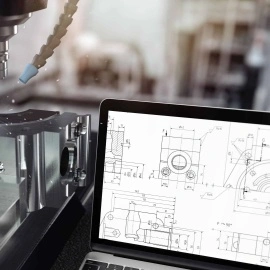
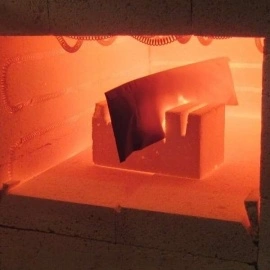
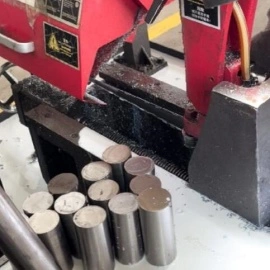
Our flanges are created via precision die forging and then CNC machining. The grain structure is improved by forging using our 4,000 tonne hydraulic press, which immediately enhances fatigue resistance and dimensional stability.
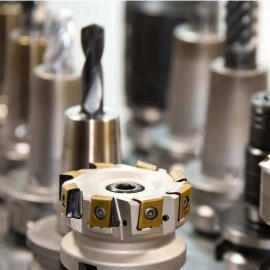
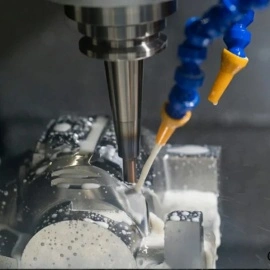
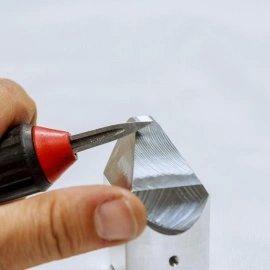
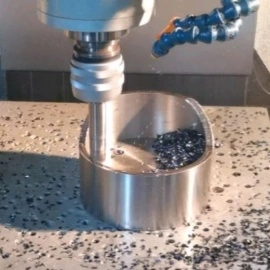
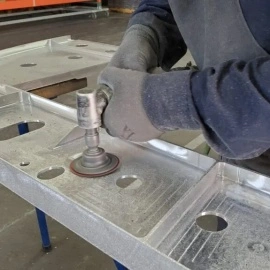
After forging, each flange is multi-axis CNC turned and milled to strict tolerances on sealing faces and bolt holes. The residual stress in the annealed state is reduced before to shipment.
All manufacturing is to ASTM, ASME and DIN standards with each stage being checked for process conformance.
Manufacturing Capability
Baoji Huacan is located in Baoji, Shaanxi, the core of China's titanium industry, known as China's "Titanium Valley". Our facility contains 40+ CNC lathes and machining centers, a 4,000 tonne forging press and modern ring-rolling equipment.
Annual forging capacity exceeds 3,000 tons. We handle everything from prototype single pieces to large-volume production runs. Both standard and complex custom flange geometries are within our capability.
 |
 |
 |
 |
 |
| melting | melting | forging | forging | rolling |
Quality Control
Our multi-stage QC process ensures every flange meets your specifications:
· PMI (Positive Material Identification): Spectrometry confirms Fe ≤0.20% and O ≤0.18%, verifying true Grade 1 purity
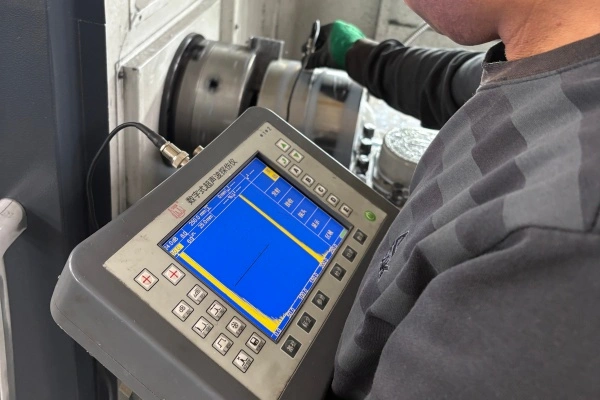
· Ultrasonic Testing (UT): Detects internal voids or inclusions per ASTM A388 / AMS 2631
· Dye Penetrant Inspection (DPI): Identifies surface cracks or porosity on sealing faces
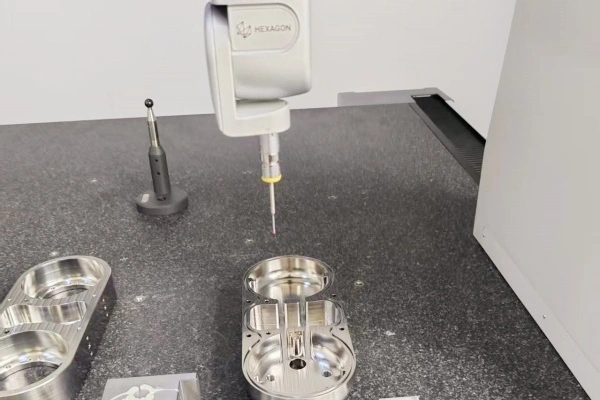
· CMM Dimensional Inspection: Verifies bolt hole tolerances and face flatness
· Surface Roughness Verification: Confirms Ra 3.2–6.3 μm on sealing faces
· Material Traceability: Full records from raw titanium sponge to finished flange
Certifications
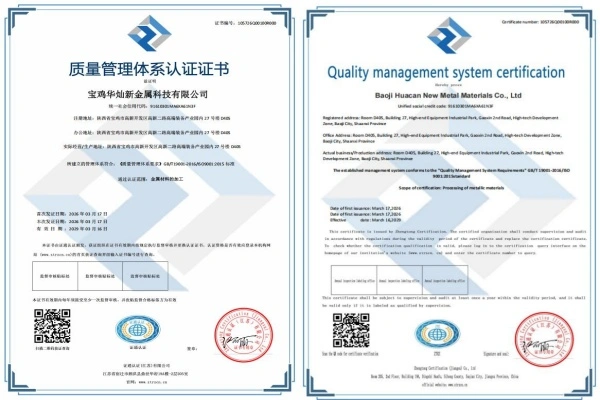
Baoji Huacan has ISO 9001 quality management system certification, including every manufacturing step from raw material receiving to final shipping inspection. All flanges are made to ASTM B381, ASTM B348 and appropriate ASME/DIN specifications. Material Test Certificates (MTC) and Certificate of Conformance (COC) may be provided on request.
Mechanical Properties Testing
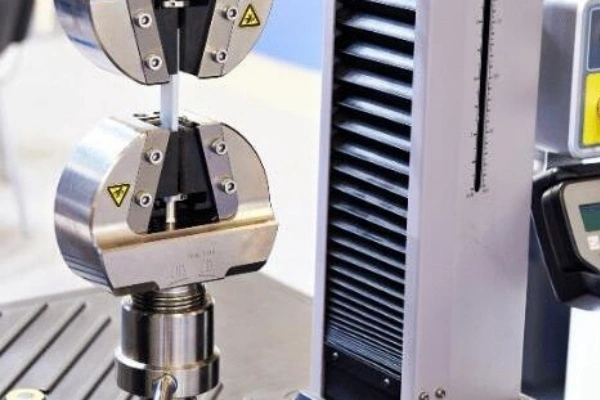
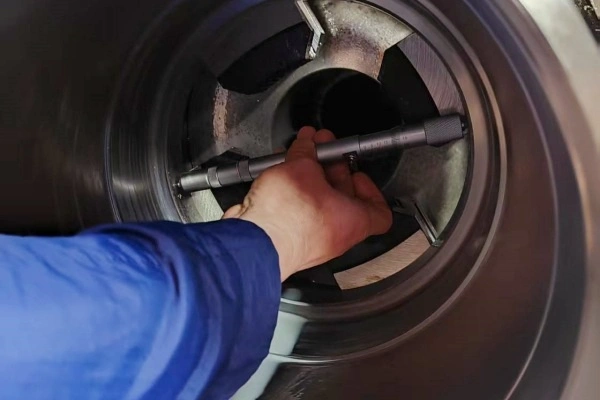
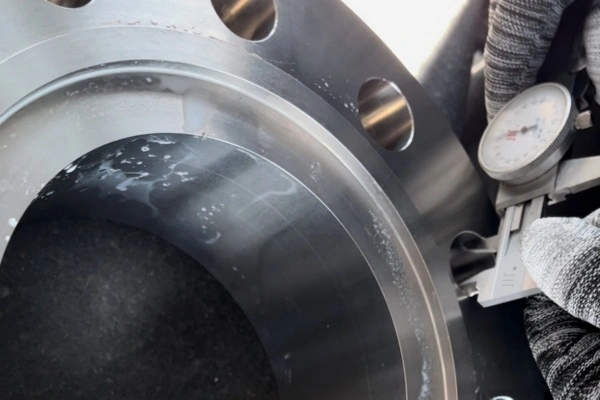
Inner Diameter Measurement
Ultrasonic Testing
CMM Dimensional
Mounting Hole Diameter Measurement
Quality Management System Certification
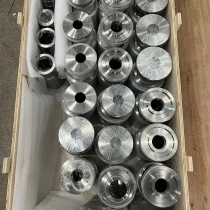
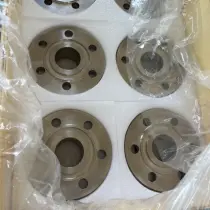
Packaging & Shipping
Each flange is carefully packaged to prevent transit damage:
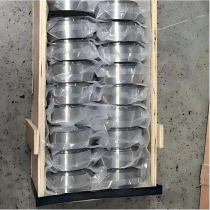
· Vacuum-sealed bags with desiccants for moisture protection
· Custom foam inserts protecting sealing faces from scratching
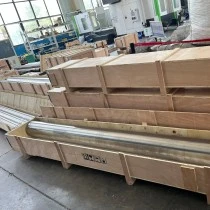
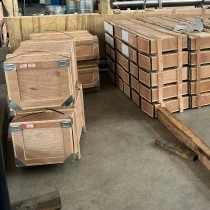
· Sturdy wooden crates for bulk or oversized shipments
· Full labeling and documentation for easy customs clearance and traceability
We offer both air freight for urgent orders and sea freight for cost-effective bulk shipments. Lead times and logistics solutions are discussed based on your order quantity and destination.
FAQ
Q: What is the main difference between the product and a Gr2 flange?
A:Gr1 has lower oxygen (≤0.18%) and iron (≤0.20%), making it softer and more ductile (yield: 170 MPa vs. 275 MPa for Gr2). Choose Gr1 when maximum formability or explosion cladding is required.
Q: Can it be used in dry chlorine gas environments?
A:No. Grade 1 titanium performs well in wet chlorine, but ignites in dry chlorine. A minimum water content (typically >1.5%) is required to maintain the passive oxide layer.
Q: Is post-weld heat treatment (PWHT) required?
A:Generally not. However, if high residual stress is present after heavy machining, a stress-relief anneal at approximately 500–600°C may be specified by your engineer.
Q: What gaskets are compatible?
A:Because Grade 1 is relatively soft (~120 HBW), use PTFE, graphite, or spiral wound gaskets. Avoid hard metallic ring gaskets that could deform the flange face.
Q: Why is Gr1 sometimes priced higher than Gr2?
A:Gr1 is a specialty high-purity grade produced in smaller batches with tighter interstitial element controls. Lower production volume means less economy of scale compared to the more widely used Gr2.
Contact Us
Ready to source a reliable gr1 titanium flange? Contact our team at sherry@hc-titanium.com with your drawings or specifications — we respond within 24 hours.




Learn about our latest products and discounts through SMS or email