Whereas some types of stainless steel may experience corrosion, titanium can keep a stable passive surface under the right conditions and offer dependable service. But titanium isn't always resistant to sulphuric acid, so technical tests need to be done before the final choice of material is made. A titanium tube sheet that is properly specified can help lower the amount of maintenance needed for corrosion and keep heat exchangers running smoothly. Before production starts, it's important to make sure that the required titanium grade, acid concentration, operating temperature, design pressure, and expected service life are all known.

Protection Against Oxidizing Environments
Titanium tube sheets have a passive oxide film that forms on their own and protects them from corrosion in many oxidising conditions. Titanium can quickly repassivate when the right chemical conditions are restored after the surface is damaged. This behaviour is useful for petrochemical equipment that has to deal with oxidising agents, changes in temperature, and process media that flow, because it keeps the surface stable.
The passive film helps protect against corrosion over time and stops localised surface damage. Because of this, titanium tube sheets can be used in some situations where oxidising process lines, heat exchangers, and chemical processing equipment are needed. The actual performance is still based on the material grade, the temperature, the makeup of the medium, flow velocity, and the design of the equipment. When the working setting is not normal for the material, physical tests or known material suitability data should be used.
High Fatigue and Corrosion-Fatigue Endurance
Temperature changes, pressure changes, vibrations, and flow-induced stress can happen over and over again to petrochemical equipment. Titanium tube sheets are useful in many engineering applications because they are strong mechanically and don't break down easily. This makes fatigue behaviour an important thing to think about for equipment that is used over and over again.
Superior Fatigue Strength
Titanium alloys that are used to make tube sheets can have good fatigue performance as long as the right material grade, heat treatment, surface condition, and loading conditions are used. Cycles of thermal expansion and contraction, changes in pressure, vibration, and forces caused by flow can put stress on heat exchanger parts. Choosing the right materials and designing things correctly can help lower the chance of fatigue crack initiation during long-term use.
When temperature differences and changing working pressures cause frequent mechanical forces, this property is especially useful. But tensile strength alone shouldn't be used to judge fatigue performance. Engineers should also think about the predicted cycle count, the stress range, the stress concentration, the surface state, the weld details, the working temperature. These things should be a part of the mechanical design and inspection plan for important petrochemical equipment so that it works well.
Enhanced Corrosion-Fatigue Performance
If you use corrosive media and cyclic loading together, corrosion-fatigue can become an important design factor. Because of their steady passive oxide film, titanium tube sheets can offer useful resistance to corrosion-assisted degradation in many aqueous environments. This mix of resistance to corrosion and fatigue performance can help keep parts in good shape when equipment is loaded and exposed to chemicals over and over again.
Corrosion-fatigue behavior relies on the metal, the surface state, the stress level, the surroundings, the temperature, and how often the load is applied. Because of this, titanium tube sheets that are properly made can be used in tough situations, like heat exchangers that cool with seawater and some chemical processing systems. When engineers choose a material, they shouldn't just assume it has a universal resistance. Instead, they should look at the expected loading spectrum and process chemistry. Inspection and non-destructive testing can give important parts more proof that they work.
Resistance to Stress Corrosion Cracking
Stress corrosion cracking (SCC) can occur when susceptible materials are simultaneously exposed to tensile stress and a specific corrosive environment. Titanium alloys generally show strong resistance to SCC in many chloride-containing environments compared with susceptible conventional alloys. This characteristic can be valuable for petrochemical equipment where sustained stresses and aggressive process media occur together.
However, SCC resistance is material- and environment-dependent. Factors such as alloy grade, temperature, chloride concentration, hydrogen exposure, residual stress, and surface condition should be considered during engineering evaluation. Selecting an appropriate titanium grade and controlling fabrication-induced stresses can help maintain the structural integrity of critical components. For demanding services, material compatibility assessment and inspection requirements should be established before manufacturing and installation.
Material Flexibility via Cladding
Titanium cladding on tube sheets can provide a practical way to combine the corrosion resistance of titanium with the structural and economic advantages of a different base metal.
Cost-Effective Performance Enhancement
Titanium-clad tube sheets can use less titanium than solid titanium construction while still adding a corrosion-resistant titanium surface to the medium being used in the process. Depending on the equipment's mechanical, thermal, and corrosion requirements, a titanium layer can be attached to a suitable base material like carbon steel or stainless steel. This method might be especially appealing for big heat exchangers, where making the whole part out of solid titanium would make the material much more expensive.
The final performance of a clad tube sheet relies on the width of the titanium layer, the choice of base metal, the quality of the bonding, the manufacturing process, and the conditions of use. If it's designed correctly, cladding can provide the corrosion resistance needed while also using less material. Before getting a clad tube sheet for petroleum service, buyers should look over the bonding method, cladding thickness, checking standards, and any other relevant specs.
Optimized Material Properties
A titanium surface for corrosion resistance and a good base metal for structural support and pressure loading can be combined by engineers through cladding. The titanium layer can protect against some corrosive chemicals, process fluids that contain chloride, and oxidising environments. The base material, on the other hand, gives it strength and stiffness.
Instead of using the same material on the whole part, this configuration can be made to fit the specifics of the process. Fluid makeup, temperature, pressure, tube-sheet measurements, cladding thickness, sealing method, and thermal expansion are all important factors. These factors should be looked at together for heat exchangers, reactors, and separation equipment to make sure the finished part meets both corrosion and mechanical needs.
Versatility in Design and Fabrication
Different shapes and sizes of titanium-clad tube sheets can be made to meet the needs of particular equipment. Depending on the materials, sizes, and production route needed, cladding can be made using well-known methods like explosive bonding or roll bonding. The bonding process needs to make sure that the interface is strong enough for later machining and service.
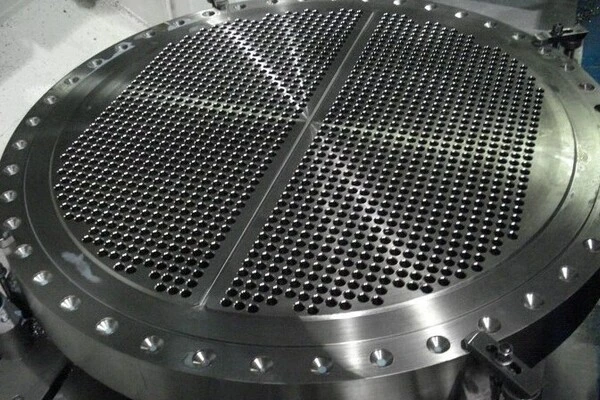
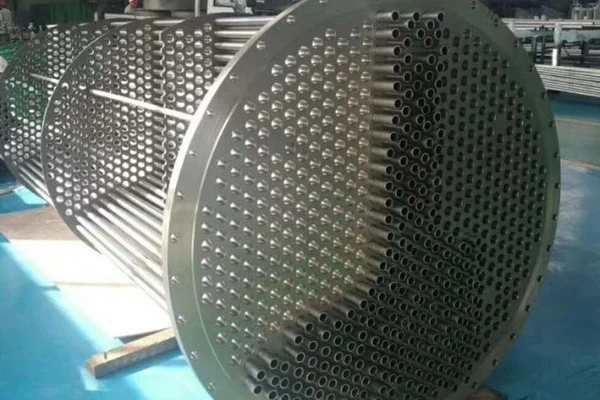
After cladding, tube holes, sealing surfaces, bolt holes, and other features can be machined according to the approved engineering drawing. Dimensional inspection is important because tube-hole position, diameter, pitch, flatness, and surface condition directly affect assembly and sealing performance. A manufacturer experienced in titanium machining can also review drawings and fabrication requirements before production to identify potential manufacturing issues.
Conclusion
Titanium tube sheet components can provide important advantages in selected petrochemical applications where corrosion resistance, cyclic loading, and long-term material reliability are key considerations. Titanium's passive oxide film supports resistance to many corrosive environments, while appropriate titanium alloys can provide useful mechanical and fatigue performance. Titanium cladding can also reduce titanium consumption when a corrosion-resistant surface is required without manufacturing the complete tube sheet from solid titanium.
These advantages should always be evaluated against actual process conditions, including chemical composition, temperature, pressure, flow velocity, loading cycles, dimensions, and applicable design standards. For petrochemical heat exchangers and related equipment, proper material selection, precision machining, dimensional inspection, and traceable material documentation are essential to achieving reliable service.
For petrochemical plant operators and equipment manufacturers, Baoji Huacan New Metal Materials Co., Ltd. provides titanium tube sheet manufacturing and machining services for application-specific requirements. Our capabilities include precision rolling, CNC machining, dimensional inspection, and non-destructive testing. We can manufacture according to customer drawings and specified material requirements, with production and inspection documentation available according to project requirements.
Frequently Asked Questions
What makes titanium tube sheets superior to stainless steel in petrochemical applications?
Titanium tube sheets can provide stronger resistance to chloride-related corrosion than many stainless steel grades, particularly in suitable seawater and chloride-containing services. The final selection depends on temperature, chemical concentration, stress conditions, alloy grade, and project specifications.
How does the cost of titanium tube sheets compare to other materials?
Titanium generally has a higher initial material cost than carbon steel and many stainless steels. However, its corrosion resistance can reduce replacement and maintenance requirements in suitable aggressive environments. Lifecycle cost should therefore be evaluated together with material price, service conditions, maintenance, and expected operating life.
Can titanium tube sheets withstand high temperatures in petrochemical processes?
Titanium alloys can be used in elevated-temperature applications, but allowable service temperature depends on the specific alloy, environment, stress level, pressure, and design requirements. Engineers should verify material compatibility and mechanical properties at the actual operating temperature before selecting a titanium tube sheet.

Ensuring Quality in Titanium Tube Sheet Manufacturing
At Baoji Huacan, quality control covers material verification, manufacturing, machining, and final inspection of titanium tube sheets. Material documentation can be reviewed to confirm the specified grade and traceability, while dimensional inspection verifies critical features against approved drawings. Depending on project requirements, coordinate measuring machines and non-destructive testing can also be used to evaluate dimensional accuracy and component integrity.
For custom titanium tube sheets, customers can provide drawings, material grades, dimensions, tube-hole layouts, quantities, and applicable standards for technical review and quotation. Contact Joy@hc-titanium.com or Sherry@hc-titanium.com to discuss your titanium tube sheet requirements and obtain an application-specific manufacturing solution.
References
1. Smith, J.R. (2019). "Corrosion Resistance of Titanium Alloys in Petrochemical Environments." Journal of Materials Engineering and Performance, 28(9), 5432-5445.
2. Johnson, A.B. and Thompson, C.D. (2020). "Fatigue Behavior of Titanium Tube Sheets in Aggressive Media." Corrosion Science, 162, 108719.
3. Patel, R.K. et al. (2018). "Economic Analysis of Titanium Cladding in Petrochemical Equipment." Chemical Engineering Research and Design, 136, 499-507.
4. Liu, Y. and Zhang, X. (2021). "Advanced Manufacturing Techniques for Titanium Components in Chemical Processing." Journal of Manufacturing Processes, 64, 1256-1268.
5. Brown, E.L. (2022). "Performance Comparison of Titanium and Stainless Steel Heat Exchangers in Corrosive Environments." Industrial & Engineering Chemistry Research, 61(12), 4589-4601.