- English
- French
- German
- Portuguese
- Spanish
- Russian
- Japanese
- Korean
- Arabic
- Greek
- German
- Turkish
- Italian
- Danish
- Romanian
- Indonesian
- Czech
- Afrikaans
- Swedish
- Polish
- Basque
- Catalan
- Esperanto
- Hindi
- Lao
- Albanian
- Amharic
- Armenian
- Azerbaijani
- Belarusian
- Bengali
- Bosnian
- Bulgarian
- Cebuano
- Chichewa
- Corsican
- Croatian
- Dutch
- Estonian
- Filipino
- Finnish
- Frisian
- Galician
- Georgian
- Gujarati
- Haitian
- Hausa
- Hawaiian
- Hebrew
- Hmong
- Hungarian
- Icelandic
- Igbo
- Javanese
- Kannada
- Kazakh
- Khmer
- Kurdish
- Kyrgyz
- Latin
- Latvian
- Lithuanian
- Luxembou..
- Macedonian
- Malagasy
- Malay
- Malayalam
- Maltese
- Maori
- Marathi
- Mongolian
- Burmese
- Nepali
- Norwegian
- Pashto
- Persian
- Punjabi
- Serbian
- Sesotho
- Sinhala
- Slovak
- Slovenian
- Somali
- Samoan
- Scots Gaelic
- Shona
- Sindhi
- Sundanese
- Swahili
- Tajik
- Tamil
- Telugu
- Thai
- Ukrainian
- Urdu
- Uzbek
- Vietnamese
- Welsh
- Xhosa
- Yiddish
- Yoruba
- Zulu
Titanium Alloys: The Future of Marine Propellers and Their Advantages Over Steel, Aluminum, and Copper
Marine power is becoming more interested in titanium alloys because they have a low mass, a high specific strength, and great corrosion resistance. But when it comes to propellers, choosing the right material is only one part of the engineering process. Performance is also affected by the shape, diameter, pitch, operating speed, engine power, shaft interface, and conditions inside the vessel. This piece looks at the actual benefits and things to think about when using titanium propellers in naval uses.
Understanding Titanium Alloys in Marine Applications
Alloys made of titanium are used in tough situations where strength, weight, and resistance to salt water are important. Because of how they are made, they may be ideal for some nautical parts and blade uses. The right material should be chosen based on the type of craft, its power system, its working surroundings, and its design needs.
Composition and Properties of Titanium Alloys
Aluminium and vanadium are two elements that are often found in titanium alloys. Due to its strength, low density, and corrosion resistance, Ti-6Al-4V is one of the most commonly used titanium alloys and may be used for naval propellers. Titanium's density is about 4.5 g/cm³, which is less than steel and copper but more than aluminium. When making a titanium blade, makers shouldn't just look at the tensile strength; they should also look at the yield strength, wear performance, elastic modulus, surface state, and manufacturing method.
Corrosion Resistance in Marine Environments
Titanium forms a steady passive oxide film that protects it well from corrosion by seawater in a wide range of coastal environments. For parts that are exposed to saltwater for long amounts of time, this can be a big plus. But the success of corrosion depends on the whole driving system. Different metals, cracks, layers, surface contamination, and the water conditions in the area can all change how a service behaves. So, choosing the right material, designing the parts, taking care of the surface, and installing them should all be thought about at the same time.
Strength and Durability of Titanium Propellers
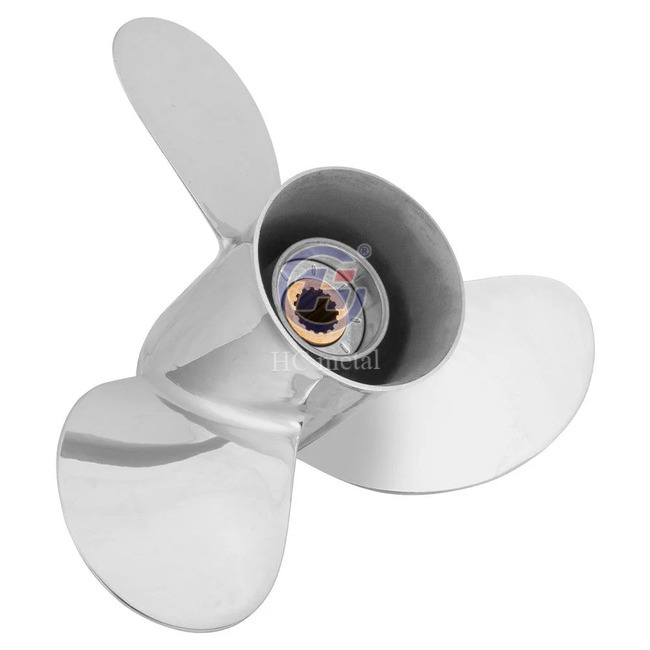
High-performance titanium propellers for boats can provide a useful combination of strength and low density in selected marine applications. Their strength-to-weight characteristics may support efficient structural designs, but blade thickness cannot be determined from material strength alone. Designers should also evaluate stiffness, fatigue loading, hydrodynamic forces, vibration, and blade deformation. Because titanium alloys have a lower elastic modulus than steel, structural stiffness and blade geometry require careful analysis.

Advantages of Titanium Propellers Over Traditional Materials
Titanium propellers can provide specific advantages compared with steel, aluminum, and copper-based materials. Titanium is lighter than steel and copper but heavier than aluminum, so its value comes from the combination of density, strength, corrosion resistance, and service requirements.
Weight Reduction and Fuel Efficiency
The lower density of titanium compared with steel and copper can reduce propeller mass when an appropriate structural design is used. Lower rotating mass may be beneficial where rotational inertia and system response are important. However, propeller weight alone does not determine fuel consumption. Efficiency depends heavily on diameter, pitch, blade geometry, RPM, engine characteristics, vessel speed, and hull-propeller interaction. Titanium may support an efficient propulsion design, but fuel savings should be evaluated for the complete system.
Enhanced Performance and Speed
High-performance titanium propellers for boats can be made to fit the needs of the boat's operation. Titanium's high strength-to-weight ratio may make it easier to change the blade parts and hub designs. The shape of the propeller and the conditions under which it is used determine its actual thrust, speed, efficiency, and cavitation behaviour. So, when designing, you should think about the diameter, pitch, blade area ratio, skew, rake, RPM, vessel speed, and wake distribution.
Longevity and Reduced Maintenance
Titanium's corrosion resistance can help it last a long time in salt water and may make some upkeep tasks easier. Titanium, on the other hand, is more expensive to buy and make than many other blade materials. Depending on the expected service life, the amount of upkeep needed, the working conditions, the performance goals, and the cost of replacement, the investment may or may not be worth it. It's better to do a lifetime review than just compare the prices of materials.

Manufacturing Processes for Titanium Propellers
To make a titanium propeller, the shaping, cutting, inspecting, and finishing must be done carefully. The way it is made depends on the alloy, the size and shape of the propellers, the amount that needs to be made, and what the customer wants.
Precision Casting and Forging Techniques
Components or whole blades made of titanium can be made by casting, forging, or cutting. Because titanium reacts chemically at high temperatures, it needs to be processed with careful attention paid to temperature, atmosphere, tools, and contamination. The method that is chosen should give the material the right state, accuracy in measurements, and mechanical qualities for the job.
CNC Machining for Titanium Propellers
CNC machining can make the blades with the right shape, hub size, and surface finish. Titanium metals need the right cutting tools and settings because they don't conduct heat very well, which can increase heat in the cutting zone and speed up tool wear. It's important to have accurate machining because differences in dimensions can affect the balance and hydrodynamic performance. For blade surfaces with a lot of small details, multi-axis CNC cutting can be used.
Quality Control and Testing Procedures
Quality control should cover both the material and finished propeller. Depending on the specification and customer requirements, inspection may include chemical analysis, mechanical testing, dimensional measurement, visual inspection, metallography, and non-destructive testing. Ultrasonic testing can be used to evaluate suitable components for internal discontinuities, while radiographic testing may be appropriate for certain volumetric defects. Dimensional inspection verifies blade and hub geometry, while static or dynamic balancing is important for rotating propellers.

Conclusion
Titanium alloys can provide a useful combination of relatively low density, high specific strength, and corrosion resistance for selected marine propulsion applications. However, a titanium propeller should be evaluated as a complete engineered component. Propeller geometry, structural stiffness, fatigue loading, cavitation, shaft compatibility, engine characteristics, and vessel conditions all influence performance.
At Baoji Huacan New Metal Materials Co., Ltd., we provide titanium alloy components and support custom manufacturing based on drawings, material requirements, dimensions, and inspection specifications. Customers can discuss the required alloy, propeller dimensions, blade configuration, shaft or hub interface, quantity, and inspection requirements with our technical team.
FAQs
Q: Are titanium propellers suitable for all types of marine vessels?
A: No. Suitability depends on vessel size, propulsion configuration, operating speed, seawater conditions, engine power, propeller geometry, and project economics. Titanium can be attractive for selected high-performance or corrosion-sensitive applications.
Q: How does the cost of titanium propellers compare to traditional materials?
A: Titanium propellers generally cost more than many conventional alternatives. Their value depends on service life, maintenance requirements, operating conditions, performance targets, and replacement intervals.
Q: Can existing vessels be retrofitted with titanium propellers?
A: In some cases, yes. Marine engineers or propeller designers should check diameter, pitch, blade number, hub dimensions, shaft interface, rotation, RPM, engine power, and vessel operating conditions before installation.
Revolutionizing Marine Propulsion with Titanium Innovation
Titanium propellers can be a practical option where corrosion resistance, specific strength, and reduced mass are important design considerations. Their performance depends on combining material properties with appropriate blade geometry, structural analysis, manufacturing controls, and inspection.
Baoji Huacan New Metal Materials Co., Ltd. supports custom titanium alloy components for demanding engineering applications. Manufacturing can be coordinated with customer drawings, material specifications, dimensional requirements, inspection plans, and project requirements.
For titanium propeller products or custom manufacturing, contact Joy@hc-titanium.com or Sherry@hc-titanium.com. Please provide the required titanium grade, propeller dimensions, blade configuration, quantity, application, and available drawings so our team can evaluate the project and discuss an appropriate manufacturing solution.
References
1. Smith, J.D. (2022). "Advancements in Marine Propulsion: The Rise of Titanium Alloys." Journal of Naval Engineering, 45(3), 278-295.
2. Johnson, M.R., & Williams, K.L. (2021). "Comparative Analysis of Propeller Materials in Corrosive Environments." Marine Technology Society Journal, 55(2), 89-104.
3. Chen, Y., & Liu, X. (2023). "Optimization of Titanium Alloy Propeller Design for Enhanced Hydrodynamic Efficiency." International Journal of Maritime Engineering, 165(A1), 15-28.
4. Brown, A.C., Thompson, R.E., & Davis, G.H. (2020). "Economic Impact of Titanium Propellers in Commercial Shipping." Maritime Economics & Logistics, 22(4), 502-518.
5. Nakamura, T., & Sato, K. (2022). "Manufacturing Processes and Quality Control for High-Performance Titanium Marine Propellers." Journal of Materials Processing Technology, 300, 117345.


Learn about our latest products and discounts through SMS or email